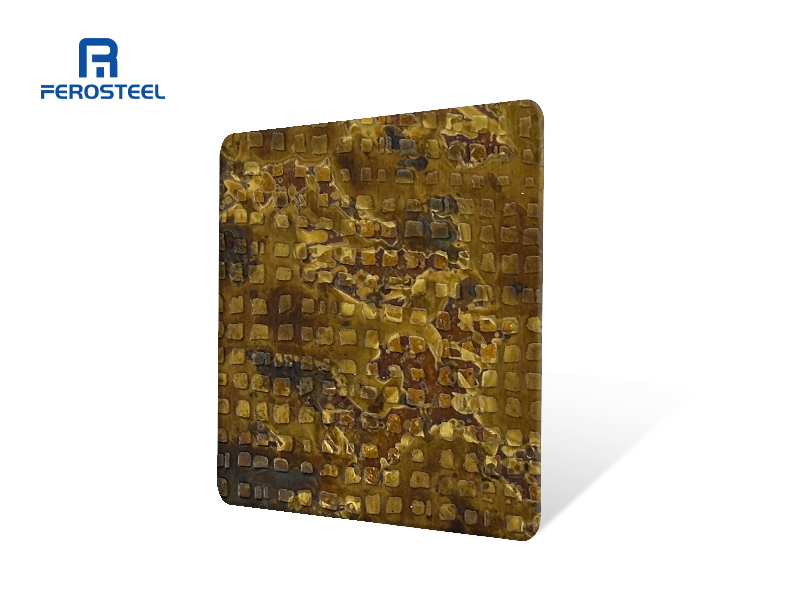
Last June, a German automotive distributor named Markus sent us a frustrated email. His customer had returned 300 stamped heat shields after just four weeks: the 0.20 mm flat sheet he had sourced had warped under exhaust temperatures, the edges rattled against the tunnel, and the OEM had halted his payment. The replacement cost—air freight, tooling rework, and the lost customer—exceeded €12,000. The root cause was not the supplier, but the specification: wrong thickness, wrong pattern, and no embossed air gap.
An Embossed Stainless Steel Heat Shield Sheet is not just a decorative piece of metal. It is a calculated thermal barrier that separates radiant heat from wiring, fuel lines, plastic panels, and battery packs. When you buy it as a commodity, you usually pay for it twice: once on the invoice, and once in the warranty claim.
In this guide, we will walk you through the exact decision framework our Foshan engineers use to match grade, thickness, pattern, and format to the application. You will learn why the embossed pattern matters more than the alloy for some jobs, when a Stainless Steel Heat Shield Roll beats cut sheets, and how to spot a supplier who is silently swapping 304 for 201.
(Key Takeaways)
- Embossed patterns create an air gap, increase surface area, and raise stiffness—three functions that flat sheet cannot deliver in one layer.
- 304 stainless steel covers most automotive and industrial zones up to ~870 °C intermittent / ~925 °C continuous; 316L is reserved for chloride-rich or salt-spray environments, not merely “higher heat.”
- Thickness is the most common specification error: 0.10–0.15 mm is ideal for lightweight exhaust shields, 0.25–0.35 mm for stamped brackets, and 0.40–0.50 mm for heavy-duty industrial panels.
- For volumes under 500 pieces, cut sheets keep tooling and inventory low; above ~1,000 pieces, a heat shield roll usually cuts per-square-meter cost by 5–8%.
An embossed stainless steel heat shield sheet is a thin stainless steel strip—typically 0.10 mm to 0.50 mm thick—formed with a raised relief pattern such as diamond, hexagonal, dimpled, or round-bean. The embossing is not cosmetic. It is an engineering feature that converts a flat foil into a three-dimensional thermal barrier.
In our Foshan plant, we describe the function as “pattern, gap, and stiffness” in one layer:
- Air gap: The raised studs or ribs hold the sheet away from the hot surface, creating a stagnant-air layer that reduces conductive heat transfer.
- Increased surface area: The textured surface dissipates heat to the surrounding air faster than a flat plane.
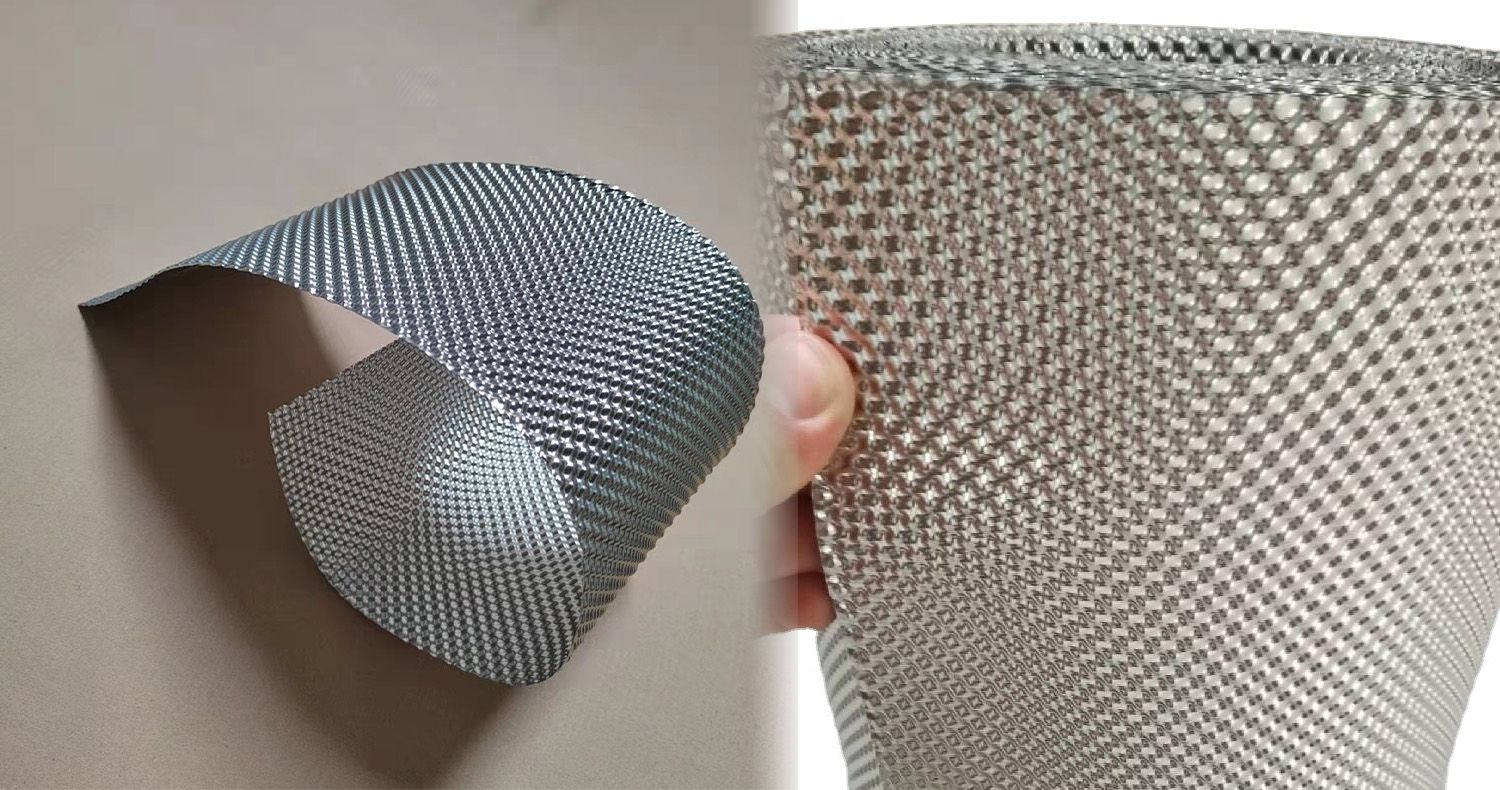
The result is a stainless steel thermal barrier sheet that can be stamped, bent, welded, and riveted while staying lightweight. For applications where every gram matters—such as modern exhaust systems and EV battery enclosures—this combination is hard to replace.
If you already know the grade and thickness you need, send us your spec. We can confirm the right embossing pattern and quote cut sheets or rolls within one business day.
Three engineering advantages explain why embossed heat shield material dominates automotive and industrial procurement:
1. Better thermal management without added layers. The embossed air gap reduces the effective heat flux reaching the protected side. Independent tests cited by automotive stamping guides show that embossed patterns aid heat dissipation by breaking up flat-surface boundary layers and increasing convective cooling area.
2. Structural rigidity at lower weight. A 0.10–0.15 mm embossed 304 stainless steel heat shield can match the stiffness of a heavier flat sheet, which matters for vehicle weight targets and EV range.
3. NVH and vibration control. Embossed panels dampen drumming and resonance. Flat sheets can act like speaker membranes under engine or exhaust vibration; the pattern breaks up the resonant frequency.
See our standard embossed heat shield sheet specifications here.
Selecting the right heat shield is not about finding the “best” material; it is about finding the material that fits the thermal load, corrosion environment, forming process, and budget of your specific part.
Most buyers start with the grade. Here is the decision matrix we use at Ferosteel:
|
Grade |
Max Service Temp (intermittent) |
Corrosion Resistance |
Cost Premium vs. 304 |
Best For |
|
304 |
~870 °C / 1,598 °F |
Very good in general atmosphere, mild chemicals |
Baseline |
Exhaust shields, engine bay liners, industrial barriers |
|
316L |
~870 °C / 1,598 °F |
Superior chloride and salt-spray resistance |
~20–35% |
Marine, coastal, road-salt-heavy, catalytic-converter surrounds |
Source: Maximum temperature data is based on the British Stainless Steel Association (BSSA) summary of ASM Specialty Handbook data, which lists 304 at 870 °C under intermittent oxidation conditions. Marlin Steel also notes 304 can tolerate short exposure up to ~870 °C and extended periods up to ~925 °C depending on load and atmosphere.
Important nuance: 316L is not automatically “better for high heat.” Its molybdenum advantage appears in corrosive environments, not in dry exhaust gas. For most automotive heat shield stainless steel applications, 304 is the right starting point. Upgrade to 316L only when the part faces salt spray, de-icing chemicals, or marine exposure.
For a deeper comparison, read our 304 vs 316 stainless steel guide.
Thickness is where most procurement mistakes happen. Thicker is not always better; thicker is heavier, harder to form, and more expensive.
|
Thickness |
Typical Use |
Formability |
Weight & Cost |
|
0.10–0.15 mm |
Ultra-light exhaust wraps, EV battery compartment liners, decorative shields |
Excellent, can be hand-formed |
Lowest weight and cost per m² |
|
0.20–0.25 mm |
Stamped automotive shields, muffler covers, turbo blankets |
Good, suitable for progressive die |
Moderate weight and cost |
|
0.30–0.35 mm |
Heavy-duty brackets, industrial equipment guards, high-vibration zones |
Moderate, requires larger bend radius |
Higher, but still formable |
|
0.40–0.50 mm |
Industrial furnace barriers, structural heat shields, severe mechanical loads |
Requires press brake or stamping die |
Highest material cost and weight |
Our 304 ultra-thin embossed heat shield sheet is supplied in 0.10–0.15 mm with a 600 mm width and heat resistance rated ≥ 850 °C, making it the default choice for lightweight automotive exhaust heat shield stainless steel parts.
Pattern selection is often treated as an afterthought, but it determines rigidity, air-gap height, and forming behavior.
|
Pattern |
Air-Gap Behavior |
Stiffness |
Best For |
|
Diamond |
Tall, consistent ridges; directional stiffness |
High along ridge direction |
Exhaust shields, underbody panels, decorative panels |
|
Hexagonal |
Uniform air gap in all directions |
Balanced multi-directional |
Turbocharger wraps, cylindrical parts, complex bends |
|
Dimpled / Round-bean |
Low profile, conformable |
Moderate, better vibration damping |
Tight-radius bends, layered composites, NVH-critical parts |
When in doubt, request samples of two patterns and run a small forming trial. The cost of a pattern trial is usually less than 1% of the cost of a line stoppage.
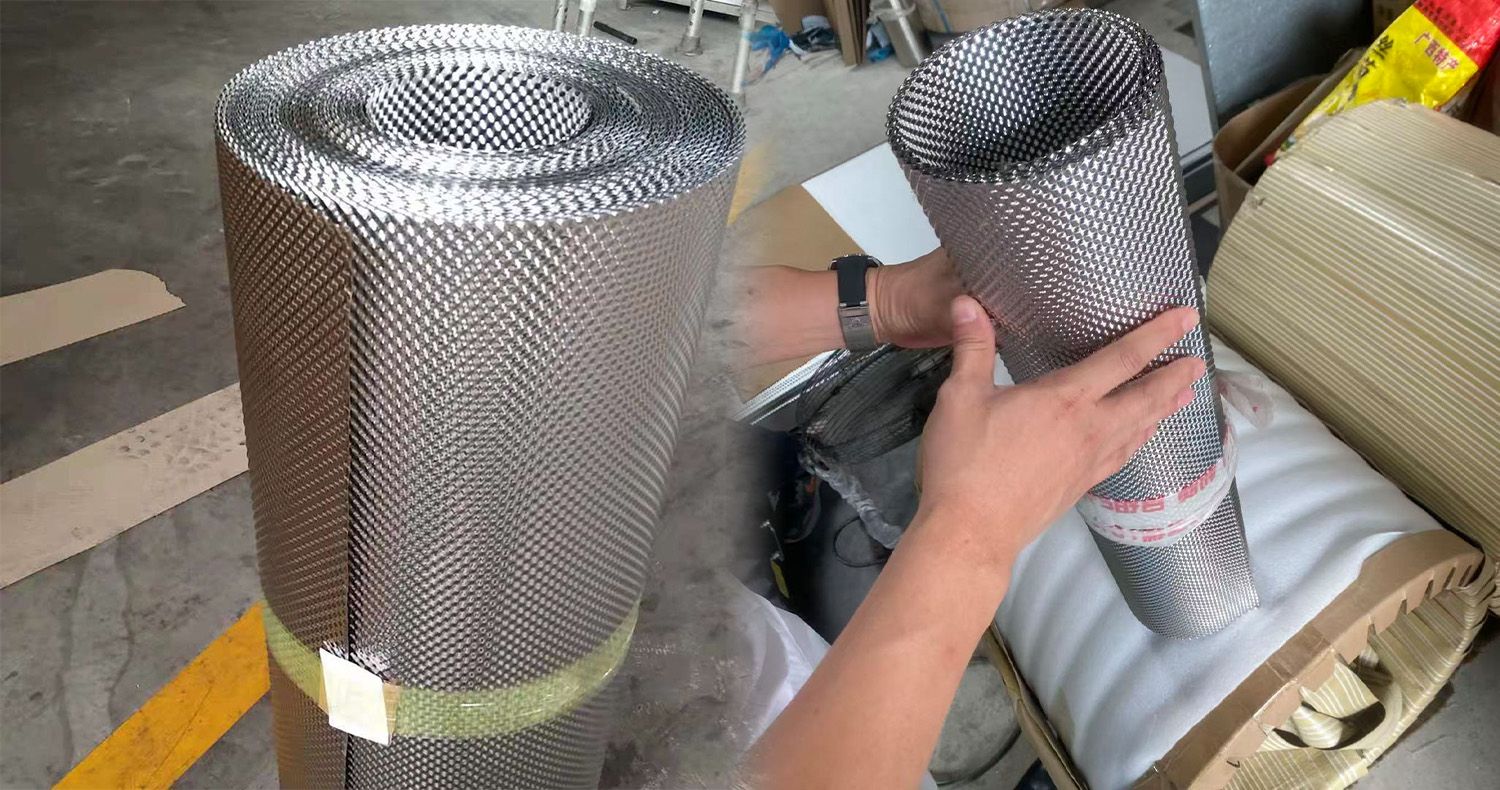
Format matters because it changes tooling, inventory, and unit economics. A Stainless Steel Heat Shield Roll is the continuous coil version of the same material, typically 0.10–0.15 mm thick and 600 mm wide, wound to lengths of 50 meters or more.
|
Format |
Best Volume |
Setup / Tooling Cost |
Per-m² Material Cost |
Waste & Labor |
|
Cut Sheets |
<500 pieces |
Low |
Higher (cutting, film, packing) |
Higher edge scrap, more handling |
|
Slit Coil / Roll |
>1,000 pieces |
Higher slitting + rewind |
Lower (continuous processing) |
Less scrap, automated feeding |
As a rule of thumb from our Foshan order history: below 500 pieces, cut sheets keep total landed cost lower because you avoid coil slitting and rewind charges. Above 1,000 pieces, the roll format usually saves 5–8% on processing and reduces lead time by eliminating the sheet cutting step.
Need a quick format recommendation? Send us your annual volume and blank size, and we will run the sheet-vs-roll economics for your part.
Exhaust pipe shields see radiant heat from 300 °C to 700 °C, plus road salt and moisture. Recommended spec: 304, 0.10–0.20 mm, diamond or hexagonal emboss. For corrosive environments, upgrade to 316L.
Turbo zones spike above 800 °C and vibrate aggressively. Recommended spec: 304 or 321, 0.20–0.30 mm, dimpled or hexagonal pattern for conformability around the housing. The embossed heat shield material must withstand thermal cycling without cracking.
Furnaces, generators, and hydraulic systems need durable covers with less weight sensitivity. Recommended spec: 304 or 316L, 0.30–0.50 mm, diamond pattern, often welded to frames.
This is the fastest-growing segment. A battery fire can exceed 800 °C, and aluminum enclosures begin to fail around 600 °C. According to Outokumpu, austenitic stainless steel can survive temperatures up to 1250 °C for over 10 minutes—critical for passenger evacuation time. Recommended spec: 304 ultra-thin embossed sheet, 0.10–0.15 mm, hexagonal pattern, used as a liner or separator inside the pack.
Mini Story: The EV Battery Sourcing Manager
In early 2025, Sarah, a sourcing manager at a Midwest EV battery pack assembler, switched from a 0.30 mm flat aluminum sheet to a 0.12 mm embossed 304 stainless steel thermal barrier sheet. The part weight dropped by 35%, the stamped shield passed the thermal-runaway containment test, and her customer reduced assembly time because the sheet held its shape during robotic placement.
We sell both, so we will be direct: aluminum is sometimes the better choice.
When aluminum wins:
- Low-temperature, reflective zones: Aluminum’s emissivity can be as low as 0.04–0.09 for bright or foil surfaces, meaning it reflects up to 90% of radiant heat (Engineering ToolBox; Shao-Yi Metal Stamping Guide). Its thermal conductivity is ~237 W/m·K versus ~16 W/m·K for 304 stainless steel, so it pulls heat away from a hot spot quickly.
- Weight-critical, cold-end exhaust: Underbody shields away from the manifold are often embossed aluminum.
- Cost-sensitive, high-volume parts:
 Office address: 26 Floor, Shibo Financial Center, Fenjiang South Road No.38, Chancheng, Foshan, GuangDong, China
  Phone
: +86 -18024913898
Phone
: +86 -18024913898 البريد الإلكتروني
: [email protected]
البريد الإلكتروني
: [email protected]


 IPv6 دعم الشبكة
 اترك رسالة