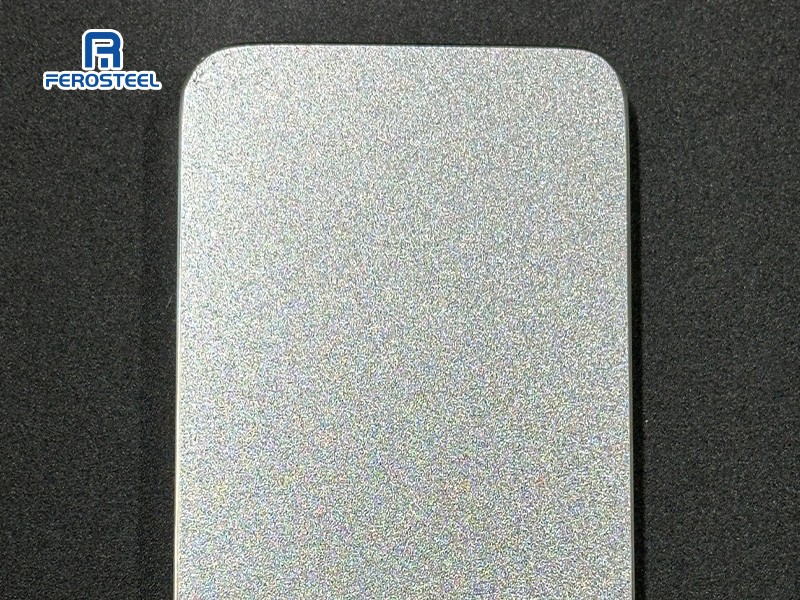
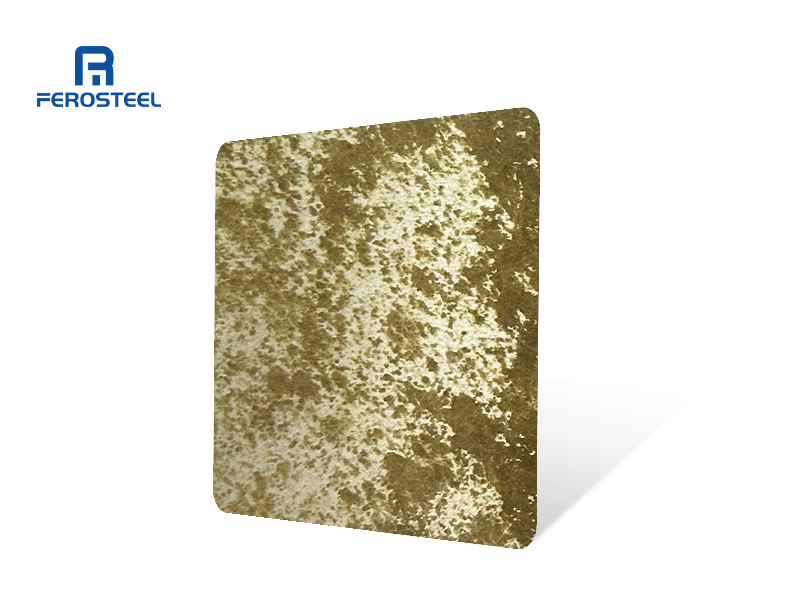
Water ripple stainless steel sheets have become one of the most sought-after decorative materials in commercial interior design. From hotel lobbies and KTV ceilings to elevator interiors and luxury retail spaces, the undulating wave pattern creates a dynamic visual effect that flat finishes simply cannot match.
If you are an architect, interior designer, or procurement professional specifying materials for your next project, this guide covers everything you need to know — from how the pattern is made, to PVD color options, specification standards, installation considerations, and how to source reliably from manufacturers.
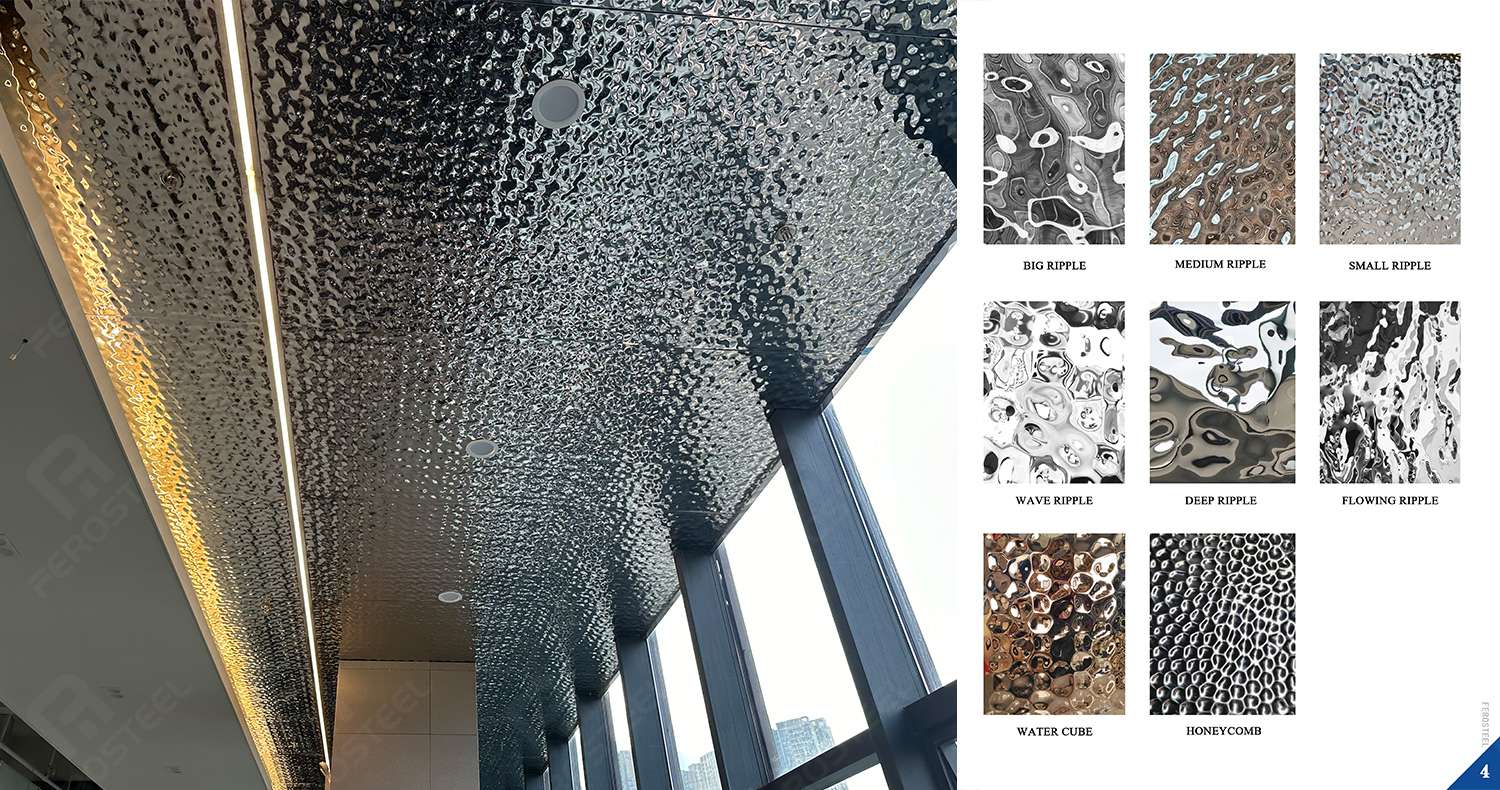
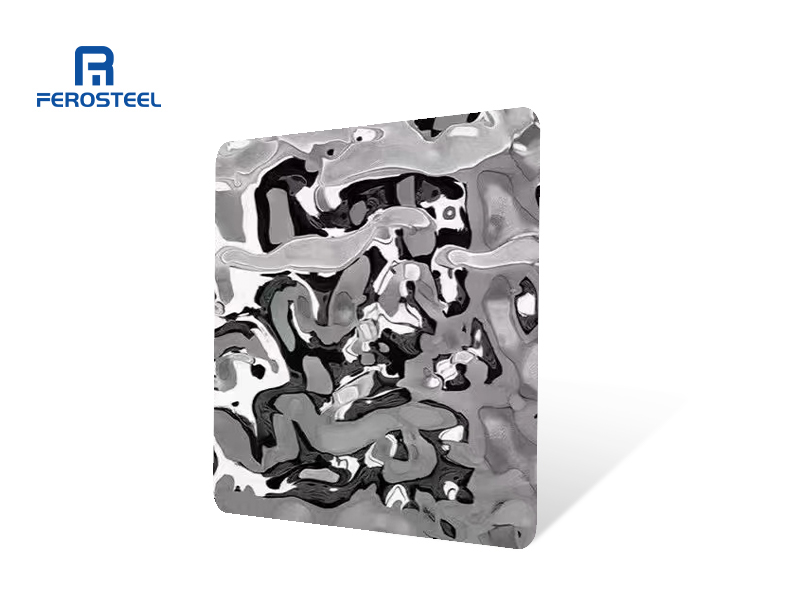
A water ripple stainless steel sheet is a decorative stainless steel panel with a three-dimensional wave pattern embossed directly into the surface. The pattern is created using precision stamping dies that press the design into the sheet in a single pass, producing a consistent, repeatable texture across the entire surface.
The defining characteristic of the water ripple pattern is its fluid, organic wave form — resembling the surface of water disturbed by a breeze. Depending on the die design, the waves can be:
| Pattern Type | Wave Profile | Visual Effect |
|---|---|---|
| Small Ripple | Tight, narrow waves | Subtle, refined texture |
| Medium Ripple (most common) | Balanced wave spacing | Versatile, works in most spaces |
| Large Ripple | Wide, deep waves | Bold, dramatic statement |
Most water ripple sheets are produced on a mirror-finish (8K) base, which amplifies the reflective quality of the waves. When light hits the surface, the ripples create a shimmering, moving effect that changes as the viewer walks past — a signature quality that has made this material a favorite for ceiling applications.
Understanding the manufacturing process helps you specify with confidence and avoid common quality issues.
The process begins with a high-quality cold-rolled stainless steel sheet, typically grade 304 or 316L. The sheet must have uniform thickness and a clean surface, since any defects will be magnified by the mirror polishing and stamping steps.
The sheet is polished to a mirror finish before stamping. This is critical — the mirror quality determines how the final ripples reflect light. Low-quality polishing results in a "milky" or cloudy reflection that diminishes the visual impact.
The mirror-finished sheet is fed into a hydraulic stamping press with custom-designed dies. The die pressure, sheet feed speed, and alignment must be precisely controlled. Poor stamping produces uneven wave depth or visible die marks.
For colored finishes, the stamped sheet undergoes PVD (Physical Vapor Deposition) coating in a vacuum chamber. PVD produces a thin, durable ceramic-like film that bonds molecularly with the stainless steel surface. Unlike traditional plating, PVD finishes are highly resistant to scratching, fading, and corrosion.
Each sheet is inspected for wave consistency, surface defects, color uniformity (if PVD-coated), and dimensional accuracy before packaging.
| Product Code | Pattern Name | Wave Type | Typical Application |
|---|---|---|---|
| WR-G71 | Medium Water Ripple | Medium, symmetrical | Ceiling, wall cladding |
| WR-S01 | Small Water Ripple | Fine, dense | Elevator panel, furniture |
| WR-L02 | Large Water Ripple | Deep, bold | Feature wall, facade |
| WR-C01 | Custom Ripple | Custom die | Brand-specific projects |
| Dimension | Inches | Common Use |
|---|---|---|
| 1219 × 2438 mm | 4 × 8 ft | Most interior applications |
| 1219 × 3048 mm | 4 × 10 ft | Ceiling panels, large walls |
| 1500 × 3000 mm | Custom | Large-scale projects |
| Custom cut | — | Project-specific |
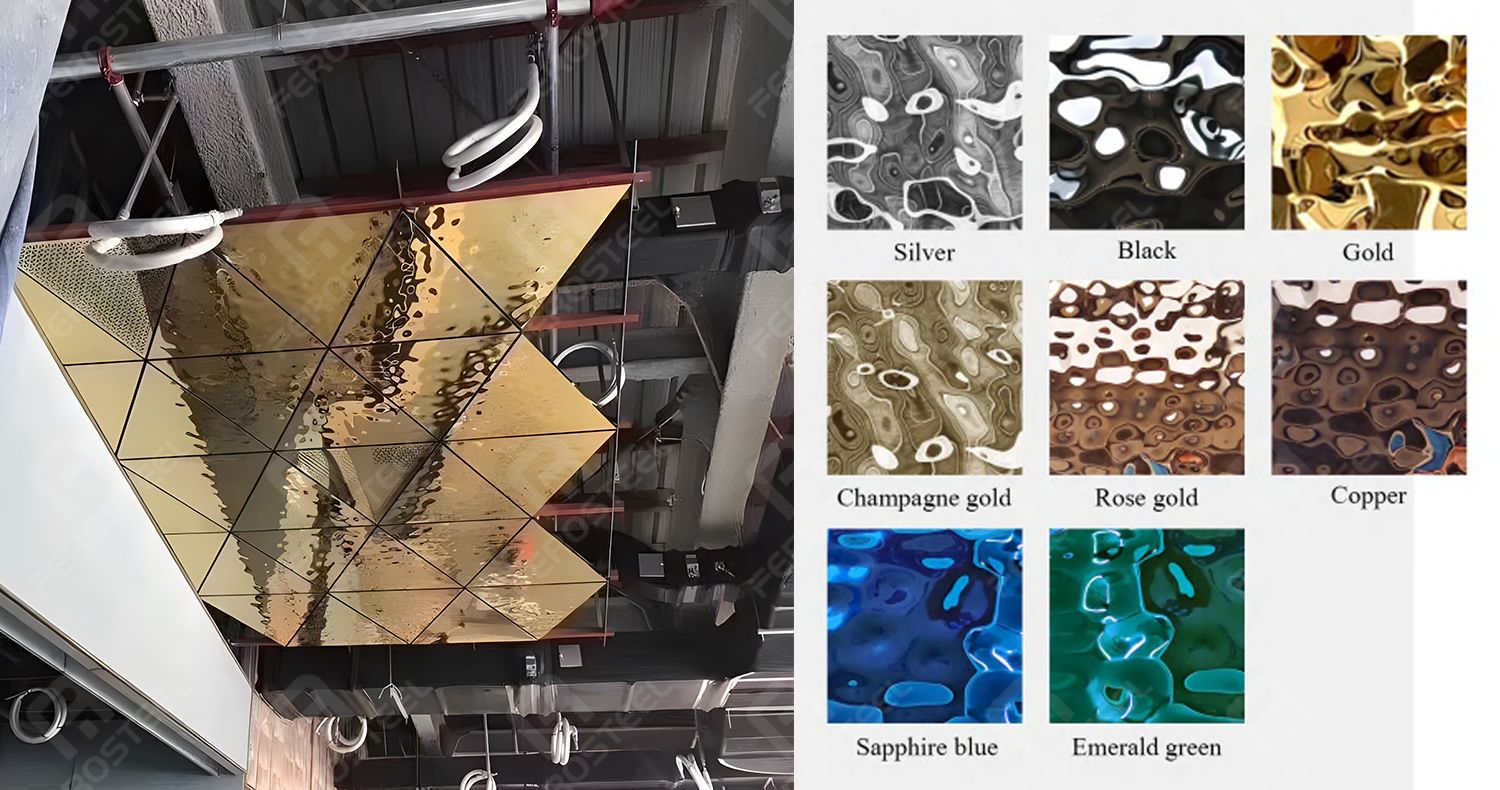
One of the biggest advantages of water ripple stainless steel is the ability to apply durable, vibrant PVD colors while preserving the reflective wave texture.
| Color | PVD Process | Design Style | Popular In |
|---|---|---|---|
| Gold / Champagne Gold | TiN | Luxury, hospitality | Hotel lobbies, restaurants |
| Rose Gold | TiCN | Warm, elegant | Retail, high-end residential |
| Black Titanium | TiC | Modern, industrial | Office interiors, bars |
| Bronze / Antique Bronze | ZrN variant | Classic, vintage | Elevator interiors, heritage projects |
| Blue / Navy | TiO₂ variant | Bold, contemporary | Brand flagship stores |
| Green | Custom PVD | Artistic, unique | Art installations, feature walls |
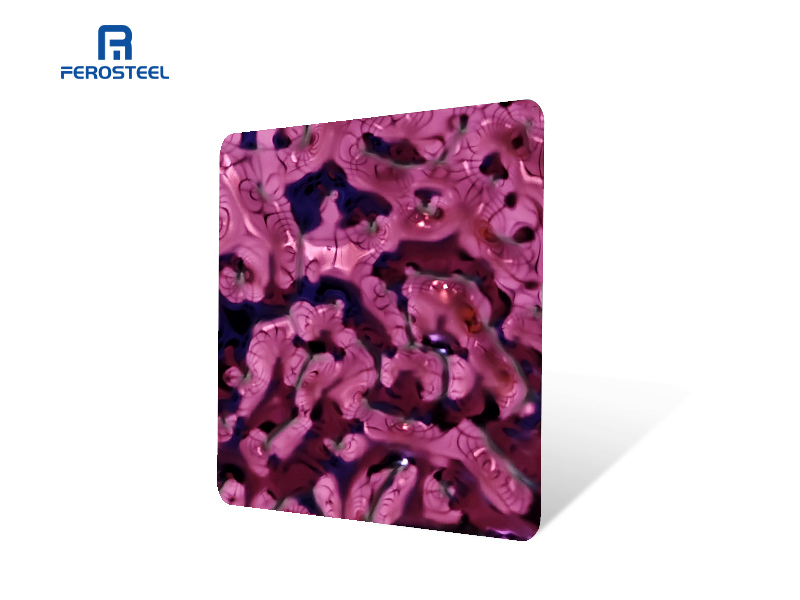
| Pink | Custom PVD | Playful, distinctive | Beauty salons, boutique hotels |
Designer Tip: PVD colors on mirror-finish water ripple sheets create a color-shifting effect under different lighting. Always request a physical sample under your actual project lighting before finalizing.
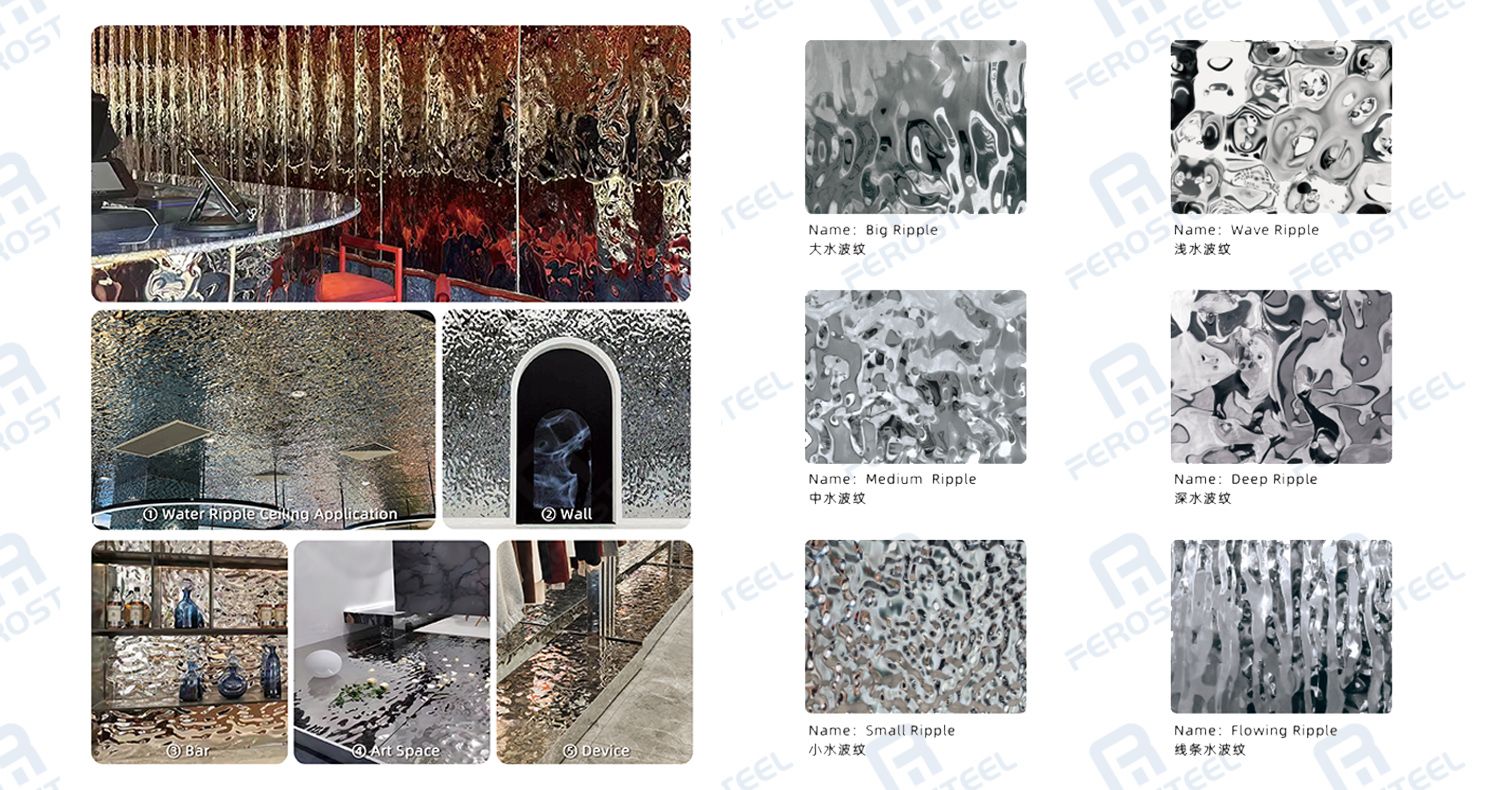
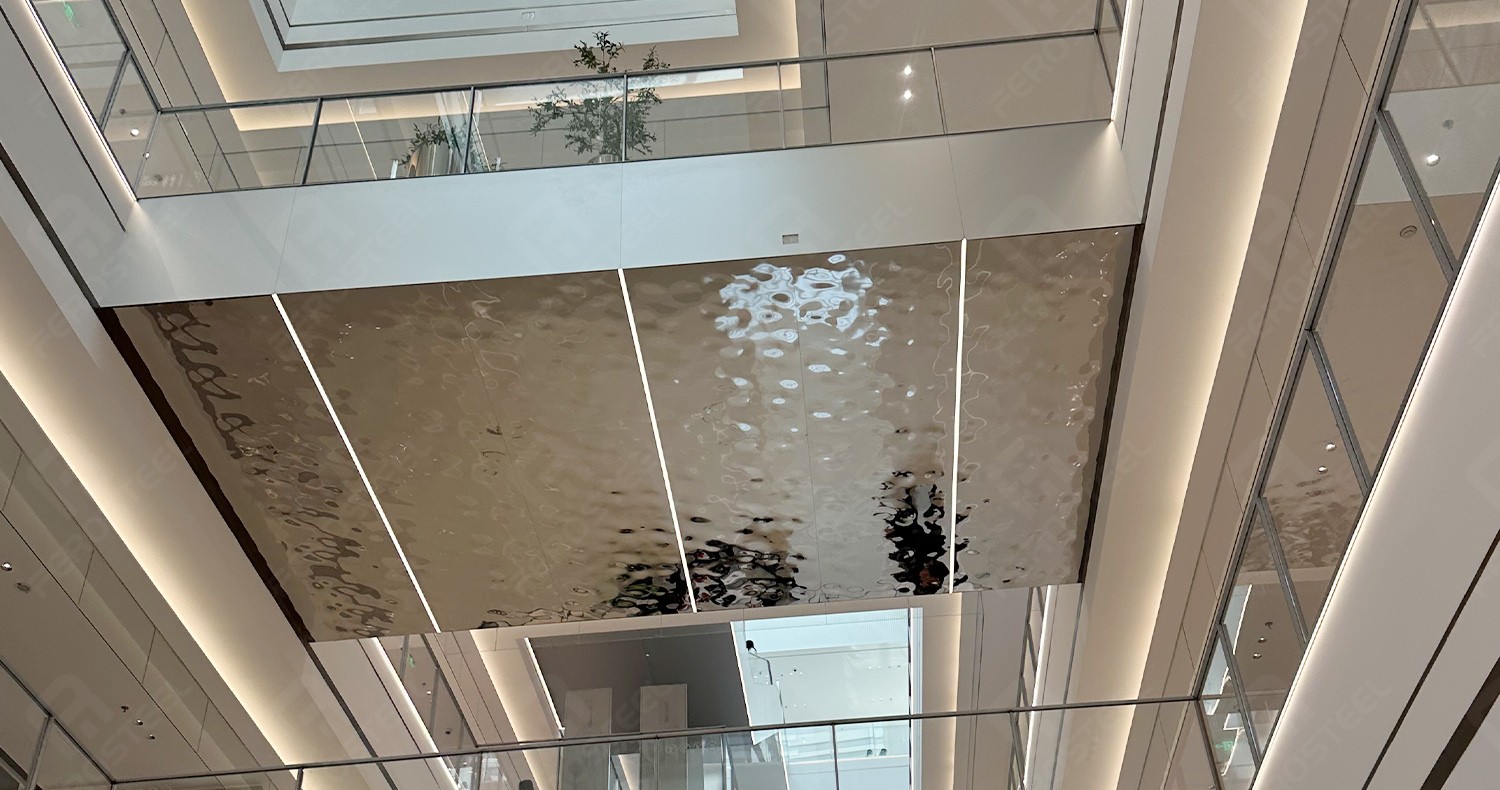
Water ripple ceilings are the single most popular application. The pattern breaks up large ceiling planes and adds perceived height. Mirror-finish or gold PVD versions amplify ambient lighting.
Specification note: For ceiling applications, use 0.5–0.8 mm thickness with a suspended grid system. Ensure the grid is rated for the sheet size to prevent sagging.
Elevator cab walls and doors use water ripple sheets to create a premium experience in hotels, office towers, and luxury residential buildings. Medium ripple is the most common choice.
Behind reception desks, in restaurant dining rooms, and in retail flagship stores, water ripple sheets serve as dramatic backdrops. Large ripple patterns work best for this application.
The reflective quality of water ripple sheets works exceptionally well with dynamic lighting systems. Combined with PVD gold or rose gold finishes, the material creates a lively, upscale atmosphere.
Round columns wrapped in water ripple stainless steel become design features rather than obstacles. The wave pattern helps disguise seams and creates visual continuity around the curve.
Custom furniture pieces — console tables, cabinet fronts, and bar fronts — increasingly use water ripple inserts for a luxury feel at a fraction of the cost of solid metal fabrication.
When writing your specification or submitting an RFQ to suppliers, include the following:
Not all water ripple sheets are created equal. When your shipment arrives, check for:
| Check Item | What to Look For |
|---|---|
| Wave consistency | Uniform depth across the entire sheet; no flat spots |
| Mirror quality | Clear reflection with no haze, clouding, or "orange peel" effect |
| PVD color uniformity | No color variation between sheets; no coating streaks |
| Surface protection | Protective film intact; no scratches visible after film removal |
| Dimensional accuracy | Length/width within ±2 mm; thickness within spec |
| Edge condition | Clean, burr-free edges; no cracking at stamped pattern near edges |
| Packaging | Sheets separated by interleaving paper; crate intact |
Most of the world's decorative stainless steel is manufactured in Foshan, Guangdong Province — often called the "Stainless Steel Capital of China." Ferosteel and many other suppliers are based in this cluster, which means competitive pricing and deep expertise.
1. Factory vs Trading Company
Work directly with a manufacturer when possible. You get better pricing, faster communication on custom requests, and direct quality control. Ferosteel operates its own production facility in Foshan with in-house PVD coating.
2. MOQ (Minimum Order Quantity)
Standard MOQ is typically 50–100 m² for colored PVD sheets (due to vacuum chamber batch sizing). Plain mirror-finish sheets have lower MOQs. Always confirm before designing your spec.
3. Sample Policy
Reputable suppliers provide physical samples. For PVD colors, a sample is essential — screen colors are not reliable for finish verification. Ferosteel ships samples internationally.
4. Lead Time
- Standard patterns, no PVD: 7–10 days
- PVD coating required: 15–20 days
- Custom die / pattern: 25–35 days (includes die fabrication)
5. Shipping and Incoterms
Most suppliers quote FOB Foshan or CIF to your port. For smaller orders, ask about LCL (Less than Container Load) options. For ceiling or wall projects, damage in transit is a real risk — confirm seaworthy crate packaging in writing.
Water ripple stainless steel sheets are low-maintenance, but proper care preserves the finish:
| Pattern | Visual Style | Best For | Price Tier |
|---|---|---|---|
| Water Ripple | Fluid, reflective waves | Ceiling, luxury interiors | Mid–High |
| 5WL / 2WL (Linen) | Linear embossed texture | Industrial, wall cladding | Mid |
| Etched Pattern | Custom graphic designs | Elevator, branding | High |
| Quilted / Square | Geometric dimples | Vintage, elevator | Mid |
| Antique / Patina | Aged metal look | Classic, heritage | High |
Water ripple stainless steel sheets offer a rare combination of durability, visual impact, and design flexibility. For architects and designers working on hospitality, retail, or luxury residential projects, they deliver a premium material look at a manageable cost — especially when sourced directly from specialized manufacturers in Foshan.
The key to a successful specification is clarity: know your grade, your finish, your pattern, and your supplier's quality standards before the order goes in. Request physical samples, verify PVD color under your project lighting, and inspect the shipment on arrival.
Q: Can water ripple stainless steel be used outdoors?
A: Yes, but only with SS 316L substrate and a UV-stable PVD coating. Even then, mirror-finish sheets will show water spotting and require more maintenance. For outdoor applications, consider a satin or hairline base finish.
Q: Can I get a custom water ripple pattern?
A: Yes. Custom dies can be fabricated, but MOQ is higher (typically 500+ m²) and lead time extends to 30–35 days. Provide your pattern drawing or sample for quotation.
Q: Is PVD coating durable?
A: High-quality PVD coating is extremely durable — rated for 10+ years indoors without fading. It is far superior to traditional electroplating. Always ask for the supplier's PVD chamber specs and coating thickness guarantee.
Q: Can water ripple sheets be cut on-site?
A: Yes, they can be cut with a water jet or laser. Standard metal saws will work but may leave burrs. Always keep the protective film on during cutting to prevent surface damage.
Q: How do I calculate how many sheets I need?
A: Measure your area in m², add 10% for cuts and waste, then divide by the area of one sheet. For example: 100 m² project ÷ (1.219 × 2.438 = 2.97 m² per sheet) = 34 sheets + 10% = 38 sheets.
About the Author: This guide is produced by the technical team at Ferosteel, a Foshan-based decorative stainless steel manufacturer supplying architects and contractors worldwide since 2015.
Related Articles:
- [304 vs 316 Stainless Steel: Which Grade for Your Project?]
- [PVD Coating vs Traditional Plating: Durability Comparison]
- [How to Choose the Right Stainless Steel Finish for Commercial Interiors]
Last updated: June 2026
 Office address: 26 Floor, Shibo Financial Center, Fenjiang South Road No.38, Chancheng, Foshan, GuangDong, China
  Phone
: +86 -18024913898
Phone
: +86 -18024913898 البريد الإلكتروني
: [email protected]
البريد الإلكتروني
: [email protected]


 IPv6 دعم الشبكة
 اترك رسالة